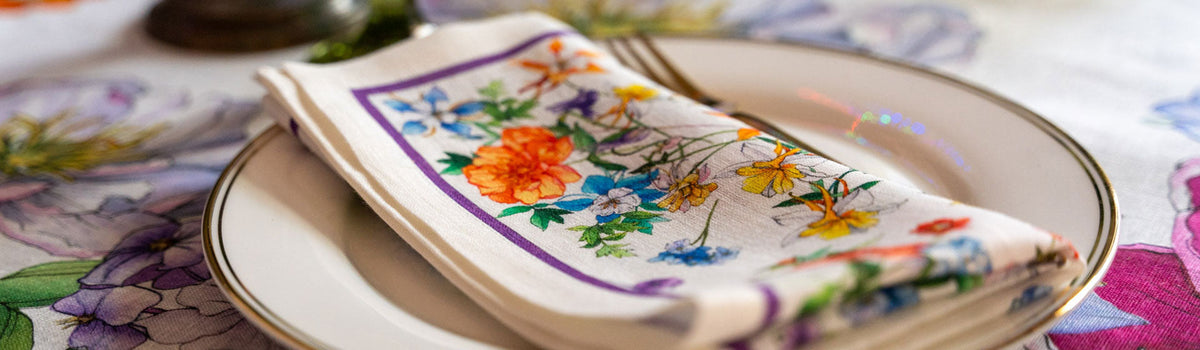
Where does the napkin go at the table according to etiquette?
How many of us have ever set the table and asked ourselves the fateful question: does the napkin go to the right or left of the plate? You'll be happy to know that it's no trivial matter at all and that, in fact, there are several schools of thought on the subject.
In this article we look at what the traditions and the most widespread trends are, what etiquette says and what options you have at your disposal to prepare a perfect mise en place !
The position of the napkin: a fundamental detail
The position of the napkin at the table is a detail that makes a difference and distinguishes a professionally set table from a more informally set one. You need to find a good balance between the plates, glasses, cutlery and the napkin so that everything looks harmonious and symmetrical.
Here is rule number one: the napkin must be pleasing to the eye but also functional. What does this mean? That it must be within easy reach, easy to pick up and use and, therefore, should never be placed under the cutlery! This is because, if you place it under the cutlery at the table, the diner is forced to move the fork and knife to pick it up. In practice, you spend time on the mise en place and your guest has to disrupt it to reach the napkin. It makes no sense, does it? But don't worry, it's a mistake we've all made.
Remember, every aesthetic choice must always be accompanied by practicality. For example, no one forbids you from folding napkins elegantly, provided that the whole thing is functional for the diner.

The napkin must be pleasing to the eye but also functional.
Tradition and etiquette: the napkin on the left
Following bon ton at the table shows a certain care and respect for tradition. According to etiquette, the napkin on the left of the plate fits the idea that guests can pick it up without any hindrance in their movements.
This, however, is not an absolute rule! It is called “English-style mise en place” and is probably the one we are most accustomed to. Some place the napkin slightly under the plate, or next to the forks; others use ribbons or metal rings so that decorated napkins also help create a scenic effect.
Attention: according to the cutlery etiquette, forks go to the left of the plate, while knives and spoons go to the right. Cutlery is arranged on either side of the plate in the order in which it will be used, starting from the outside. This means that the napkin must be placed to the left of the forks.
Naturally, you can choose a color that matches the floral centerpiece or the chargers, or you can echo the pattern of the table runner, anything goes as long as the result is elegant and balanced.

Napkin on the right: when and why to choose it
If you thought that placing the napkin on the right was a mistake, you were wrong. The "French-style mise en place" actually calls for the napkin to be on the right of the plate. The reason? For a practical matter: most people eat and cut with their right hand, so having the napkin within easy reach might be more intuitive.
The position of the cutlery is the same, however, according to French tradition i the tines of the forks should face down. This is because, in the past, the back of the cutlery was engraved with a family crest that was a symbol of prestige and refinement.
In this case too, nothing forbids you from creating decorations with napkins if you want to add a touch of creativity, as long as they do not hinder movements and do not upset the overall harmony.
How to match the napkin with the other elements on the table
It is important that the mise en place follows a central theme both in terms of colors and shapes. The napkin must dialogue with the rest of the setting and everything must seem to be in its place.
- Materials: the choice of fabrics is fundamental. For example, linen napkins should be matched with a tablecloth or a runner of the same material to create continuity.
- Colors: the colors of the napkin must be in harmony with those of the other elements. Our advice is to choose chargers or a runner with similar shades or patterns.
- Measurements: the size of the napkins must be suitable for the occasion, as well as the tablecloth measurements. Remember that cloth napkins tend to be larger than paper ones and that the tablecloth should overhang the table by about 25-30 cm.